Search This Blog

Tuesday, July 12, 2022

ROCKIN' AT ROCK SPRINGS PARK

 The folks who really knew me early on said that I took after the McCloskey side of family, especially 

in the looks, that I took after my grandfather, William McCloskey.  This clan originally hailed from the 

Johnstown, Pa area.  We had relatives who died in the Johnstown Flood and who fought for the Union at 

Gettysburg.  My grandfather and his wife Mary Pearl Angus McCloskey had two daughters: my mother 

Elmina and her older sister Evelyn.  Together the two McCloskey girls would go on to bear 12 girls and 

two boys.  I suspect the reason everyone in this clan said I resembled my grandpa was because I was a 

male.


From left to right: Auntie Evelyn Lawrence, Sharon Lawrence, Grandma McCloskey, Elmina Petras

        Anyhow, every summer my Uncle Ray and Aunt Evelyn loaded up their bus (they had ten of the 14 

kids) and met us up at Rock Springs Amusement Park in Chester, West Virginia for rides and a picnic.  

Auntie Evelyn made the best potato salad ever, Pennsylvania Dutch style. The kiddie rides at Rock 

Springs were pretty memorable, too.


Safely landed, with sister Elaine as navigator.

    During my kiddy ride days, my Aunt Evelyn was still a few kids shy of having a full battalion.  

Cousin Richard was six years older than I, and I had always hoped mom and Auntie would someday 

pop out a boy whom I could beat up.  I was five when my parents brought home my third and youngest sister, 

Elaine, whose introduction to me was pretty much summed up by my house-welcoming to her: “Oh, no, not 

another dumb girl!”

            “Auntie,” by the way, is a term of endearment of the mountain folk of Pennsylvania Dutch.  On the Petras—Slovak—side we always said “Aunt.”


Judy and I sharing a boat at Rock Springs

 The kiddie rides at Rock Springs were especially memorable, thanks to my family’s passing down tales through the generations of the horrors that had befallen them at Johnstown.  And it all started because of an earthen dam upstream constructed by rich people,  like Andrew Carnegie and Henry Clay Frick. Because of this catastrophe, my mom never trusted anything put together by man.  When we rode the tethered airplanes at Rock Springs, Mom expressed her concerns that their cables would snap and fling us back to Johnstown.  Mom equally voiced her fears that the kiddie boats would sink and we would drown like Great Aunt Auntie Suzanne Buck, the kiddie cars would crash and give you seven kinds of whiplash.  As far as the mammoth wooden wonder, the Cyclone Roller Coaster went, you could get stampeded to the size of an Amish throw rug just by standing in line.

            Probably the kiddy ride I remember the most in my kiddy days was the Ferris wheel. Rock Springs smelled like buttered popcorn and cotton candy.  And I could smell these sweet aromas as I wheeled around and around, listening to the calliope of the merry-go-round and the laughter and screams on the big boy rides. Suddenly I stopped wheeling around and my carriage, with me still inside it, stopped at the tip top.  And I started thinking about Great Auntie Suzanne, how she clung on to that tree branch until her Pennsylvania Dutch grip let go and she was swept away with the raging Little Conemaugh River, and I started trembling and my trembling started rocking the carriage, and I let out a scream, but returned to earth safely, more mature from the firsthand experience,  bearing my park souvenir of electrified white hair.


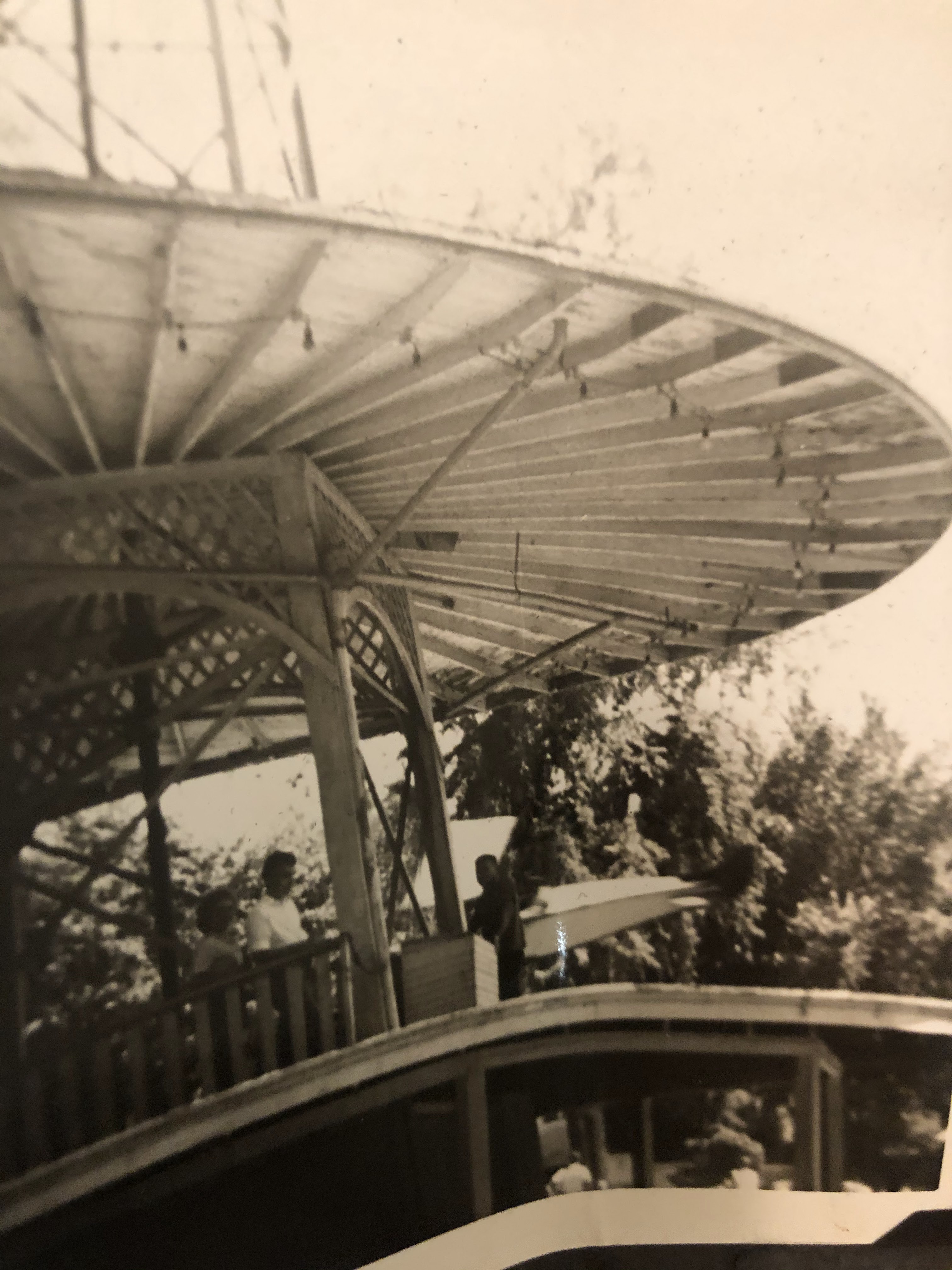
At the top left is our tethered airplane right before its cable snapped and flung us to Johnstown.

The tethered planes platform. sometimes known as the launch pad

       A few years later, I did not think girls were so dumb, just those I was related to.  Near the end of the 

school year, 7thand 8thgrade at SC Dennis Junior High would load up the buses and take us to Rock 

Springs Park for the day. I was in Seventh Grade and rode the Cyclone, bumper cars, tilt-a-whirl with a 

pretty blonde eighth-grader Debbie Westlake, and we went on the tunnel of love quite a few times.  I 

even worked up the courage to put my arm around her shoulders. Debbie was my girlfriend that 

summer.

            I really can’t remember any more memorable experiences at Rock Springs after my tunnel-of-love summer.   I remember becoming self-conscious about pimples and nose hair and tattle tell sisters.  But the wildest amusement ride of all is life itself, and my wife Debbie (Minor) and I had our first born, a girl, of course,  in 1976.  Most everyone says Severine looks like me; so she must take after the McCloskey side of the family in the looks department, but not the Johnstown fears.  She, together with our son and their spouses-- Felipe and Brandie --have four girls and two boys.  I believe it’s a good time to endear these beautiful women in the family by calling them Auntie.  

We have enough in the family now to participate in a good go at bumper cars.

            Rock Springs Park closed in 1970, the year before I graduated from Toronto High School.  But every once in a while every summer I go back to Rock Springs for a spin or two in the front car of my memories.
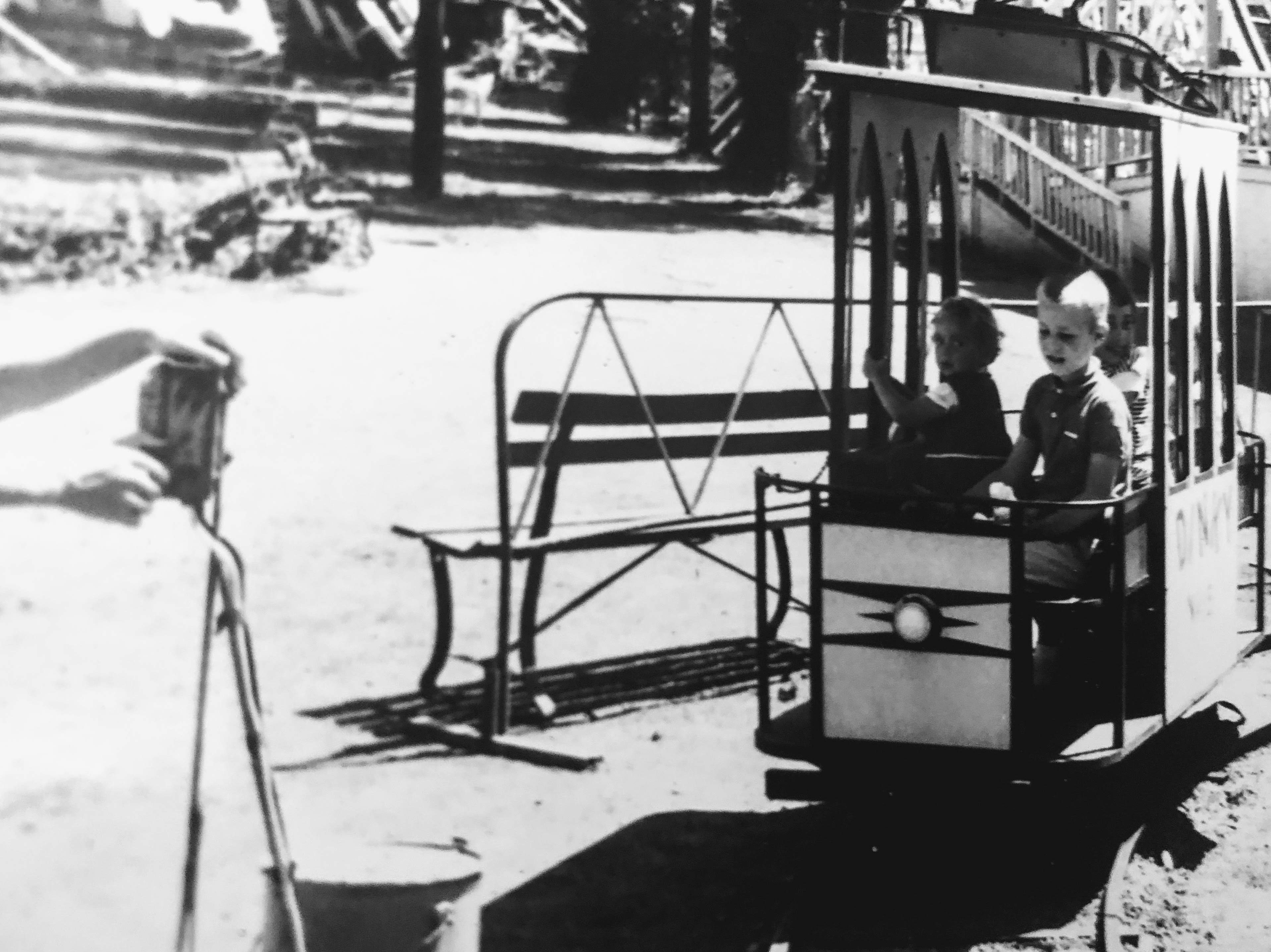
 

Moments before derailment


My last time on a Ferris wheel--ever

Auntie Evelyn on stampede look-out in front of the Cyclone


A BABY BOOMER'S SUMMER DAY

            When I was growing up, my dad worked at Sears and Roebuck.  He didn’t have any stock, but he had a lot of stock sayings.  He especially liked to blurt “money doesn’t grow on trees.”  He blurted “money doesn’t grow on trees” so much I suspected he was hiding something.
            I like to attribute my father’s frugalness to being a child of the Great Depression, as were most of the parents of my generation—the Baby Boomers.  By the way we lived it up back then, you would have thought the Great Depression ended with the landing on the moon. 
            Only rich people had color television sets back in our day.  The average family had one console tv, a monstrous rectangle of wood and plastic that could have been a recycled coffin.  These black-and-white monsters squatted upon the living room floor and received black-and-white transmissions from the lightning -rod antennas snugged to the chimneys, the tines on the antennas with spans as long as the Market Street Bridge.  On a good day, they could pick up fuzzy transmissions clear to western Pittsburgh, depending, of course, upon on how high your house stood on a T-town hill.
            Often, when some neighbor was operating a power tool, the broadcast emitted on your coffin emitted enough static and white squiggly thingies to make your standard RCA casket look like a snow globe.  Other times, the vertical control went bonkers, resulting with a never-ending black-and-white image steadily dripping from top to bottom, a visual torment as excruciating as the infamous Chinese water torture.
            Whenever the vertical took the eternal horizontal, you brought into the living room the little shoe box portable your mom watched game shows and soap operas on and mounted it upon the lifeless snow globe.  Every night, you participated in the family squint fest watching the only channel the rabbit ears would pick up—good, old Channel 9.  The television remote back then consisted of the youngest son, who had to physically hike from the couch to the microscopic tv to turn by hand the volume and blasted vertical control.  Often, he had to hold one of the aerials so that the reception improved.


No one had private swimming pools or jacuzzies in our day, if they did their name was Clampett.  The closet thing that came to a private swimming pool was if you lived within the proximity of a creek and it was dammed and had lazy spills and pools.  We swung into the cool flowing waters of the creeks from monkey vines and had chicken fights and other challenges with our friends while our pop chilled within the shallows of the creek.
            None of us lived in air-conditioned homes back then.  In the Petras manor, we had one condition—“Either stay inside or out,” another stock saying of my dad.  We had screen windows on the house and one fan that was about the size of the box that package the television, the one the size of box the Keds came in.  Whenever a hole developed in one of the window screens, my mom would darn it with a needle and thread.
            Our family cars provided little relief from the summer sun.  On the hottest days, we rolled the windows completely down manually with hand cranks as stubborn as tow truck winches.  For extra BTUs, you would accelerate the MPHs.  Additional climate control could be maintained by moving these little triangle panels of glass in front of the passenger and driver’s windows.  It was only when I was taking Driver’s Ed that I learned these little glass jibs were called “vents,” not “cigarette disposal ports.”
            In a Baby Boomer’s booming day, self-propelled and self-motivated usually resulted from a gentle nudge toward the lawn from a father’s steel-toed work boot.  Steel rule usually awarded lawn care duties to the designated television remote, or so titled at 1017 Biltmore Avenue the “aerial- holding specialist.”
            We indeed had one of those push mowers you sometimes see in a museum.  Our so-called push mower was more like a mush mower because it required to budge it a smidgen the lean and the leg power of an Iditarod sled dog.  The mower paddlewheeled glass clippings, dandelions and dust while chirruping like a Bill Mazeroski baseball card in the spokes of a bicycle.
            After zigzagging swathes of lawn that resembled a cornfield maze, you rewarded yourself with a cool drink from your outside drinking fountain, more commonly known as the garden hose.
            There must have been something rejuvenating about the taste of rubber-flavored water.  We always had plenty of energy remaining for a game of sandlot baseball.  In our day, we didn’t have composite-alloy bats.  “Graphite” we called “lead,” and it was inside our standard number 2 Ticonderoga pencils, and the wood of the pencil was probably the same wood our bats were made from.  If you swung the 28-ounce Ticonderoga bat and connected the hardball smack dab on the trademark, the bat handle would crack and need some repair because we didn’t have extra bats.  We would mummify the bat handle with black electrical tape that we would borrow from some father’s toolbox and use the bat over and over until it was reduced to a mere tent peg.
            The leather from the hardballs would also peel off as would the compressed yarn comprising the ball’s guts.  Again, we would repair it with a generous raveling of borrowed electrical tape.
            On the Baby Boomer sandlot, we did not have batting gloves to reduce the sting of contact with the hardball.  Believe me, hitting a taped-up Spalding with a tape-reinforced 15-inch Louisville Slugger emitted an aftershock you felt clear up to your ears.  To reduce the sting to a mere 5.5 on the Richter scale, we would spit into our palms and rub a generous helping of dirt into them.  Come to think of it, we didn’t do much handshaking after games.

            I like to think I have come a long way from those booming Boomer days.  Now, after a few hours of mowing grass on my John Deere X330, I like to hang out at my pool with a glass of Cabernet.  My wife Debbie says that my wine would best pair with a brown paper bag.  My taste buds have progressed, as well.  I can detect traces of black cherry, chocolate, tobacco, with a very big finish of garden hose.

Tuesday, October 26, 2021

A HAPLESS HALLOWEEN--THE 1970 MUD BOWL

          It was a game that should not have been played, a game that was more about the field than what happened on it.  The field for at least one night was haunted, maybe because Halloween had something to do with it.  Most likely a three-day blow of incessant rain had left Wheeling Island Football Field with a battered stucco surface.


            Back in 1970, five Wheeling high school teams –Triadelphia, Warwood, Linsly Military Academy, Wheeling Catholic Central and Wheeling—called the island stadium home, not to mention their freshman and junior varsity squads.  Multiply five by the games that were played nine weeks into the West Virginia season and the result was a field trampled by a constant stampede of human beef.

            Then came Halloween on Saturday and Mother Nature turned into a mischievous witch wearing Linsly colors and cast a spell at the Mischief Hour of 12 pm and ceased the rain, leaving time enough to dry the field into clay with a texture of Play Doh.  

There had been some concern the upcoming football game between the Toronto Red Knights and the Linsly Military Cadets would be canceled because of flooding.  A win would continue the Red Knights’ quest to become the team with the second greatest win-loss record in school history with a 9-1 season.

Senior Center Ron Paris


            By the time visiting Toronto disembarked from the school bus, the first thing most players noticed was that the only grass remaining on the field were four little triangles in the rear corners of the end zones.  A few fragments of chalk lines somewhat suggested a hint of former occupancy by some organized entities.  The field did have a surreal Zen-like quality; you could see the reflections of the floodlights in a thousand or so mini-puddles.

            The opening kickoff pretty much summed up the game for the visitors.  Red Knight return man Bob Morris collected the ball somewhere around the 20 and scooted downfield 40 yards, unfortunately the last 30 were out of bounds.


            “I thought I was going to go all the way,” said Morris, a longtime football coach and an inductee in the Toronto High School Athletic Hall of Fame.  “But I guess I was a tad out of bounds.”

            The uncharted runback by the 1971 THS graduate turned out to be the longest play of this Halloween eve for the Red Knights.  They would not gain a first down until the fourth quarter.  Linsly would gain four first downs, all on runs more than ten yards.  Besides those four runs, the Cadets pretty much went backward in yardage the remainder of the game.

Bob Morris posing in the Red Knight 1970  program

            “I remember the DB guarding me, his name was Tom Tribett,” Morris said.  “I remember telling him after the first few minutes of the game, ‘Let’s not get in this shit if we don’t have to.’ Well, by the end of the first quarter, you couldn’t tell who was or who wasn’t on your team.”

            “We changed jerseys at halftime,” said quarterback Bob Eshbaugh, another THS 1971 grad and Hall of Fame inductee.  “I wasn’t worried about getting the ball from center but getting my feet out of the mud.  It had suction and was up to my shins.”


            The ball was on the ground more than in the air, courtesy of 14 fumbles to 11 forward passes.  Had the sport been baseball, the ball would have been illegal because of the aerial tricks a doctored ball could do.  The only tricks during this game were sleight of hand-- now you have it now you don’t-- as exhibited on the first drive of the game when center Ron Paris long snapped a ball that stuck in the mud three feet behind him.  On film, it looked like the senior snapper laid an egg, which Linsly promptly collected.


            “I remember,” Morris said, “someone lost his shoe in the mud on the field and during the game the refs took the football to the faucet on the stadium wall and just hosed the mud off the football.”

            Toronto outweighed the host team by 20 to 25 pounds a man.  Usually on a wet surface, the heavier team holds a big advantage, but in this kind of quicksand, the lighter team simply doesn’t sink as deep.


            At 6’ ½”  and 202 pounds, senior Red Knight Tom Lowery was the second heaviest player on the field that evening, two pounds lighter than fellow tackle Ted Butler.  “It was terrible conditions that night,” Lowery said.  “You couldn’t do anything on that slop.  I remember looking at Ted Butler after we made a tackle and all I could see was his eyes with that mud all over him.  It was funny as hell.”

          Remarkedly, there were zero penalties called on either team.  The closest any infraction that could have been called was the opening kickoff when the Cadets gang- tackled Morris five feet out of bounds.  Had an ineligible lineman went out for a pass, the referees wouldn’t have known it.  Of course, getting the ball to any receiver was the problem.  By the fourth quarter the ball was as heavy as an anvil.  “I had to shotput the ball,” Eshbaugh said about his passing form.


            In the fourth quarter,” Toronto and Linsly squared up with a goal line offence versus a goal line defense with the Toronto offense utilizing running back Jim Franke.  Franke’s flatfooted style proved him to be what they call in horse track lingo a mudder.  Behind a seven-man front and full-house backfield, he and Steve Jones ploughed for four consecutive first downs to the Cadets’ 12-yard line.  But the Knights could push no farther because, unfortunately, for both teams this was the worst end of the field regarding game conditions.  Compared to the other end, which still had some traces of chalk lines, this end of the field more resembled land recently washed by a receding flood.  The Cadets fumbled the ball right back to the Red Knights.  Again, Toronto could not wallow beyond the 12.  And Linsly promptly coughed up the anvil back to Toronto.  On a final desperate attempt to scramble open to get a shotput off toward the end zone, Eshbaugh slipped to the floodplain while trying to change direction, ending the game tied at zero.


            “We took our showers with our uniforms on,” Eshbaugh said.

            “I remember getting hosed down with water after the game to get the mud off and having your shoe strings cut so you could get them off,” Morris said.

            Summing up the game, Morris said, “The line couldn’t get any footing, receivers couldn’t run routes and running backs couldn’t run.  Everything seemed to be in slow motion.”

            Toronto experienced only one injury and that didn’t occur until after the season when two-way senior Bill Sloane missed the first part of basketball season because of blood poisoning, his condition attributed to the mud from Wheeling Island Stadium.


            “We should have never played on the field,” Morris said.  “We had a good team and would have crushed them on a dry field.  I know Coach (Wilinski) was hot about the field and game, and we never played Linsly for a long time after that.”

            “All I know is we would have killed Linsly on a dry field,” Lowry said.  “Wellsville beat them 50-0 on a dry field.”

            Wellsville was the only team to beat Toronto that year by six points in another freakish game.  After the Mud Bowl, the Red Knights defeated their next two opponents by a combined 92-18 points to finish the season with still the second greatest school record at 8-1-1.


            I am not so sure we would have blown them out on a dry field," said Bob Petras, a two-way senior lineman.  "Defenses that lined up in a 52 always gave us problems on offense.  Carrollton, J.U. and Linsly manned 50 alignments with a middle guard, which eliminated our trapping the tackles and made pulling around the opposite ends slower, and those were our bread-and-butter plays.  Still we should have beaten Linsly by two, three scores.   Like the Wellsville game, when we suffered  injuries and illness and lost Eshbaugh to ejection, the Mud Bowl, 50-some years later, still haunts me.  We were so so close to having a perfect season."


CHECKEYE


Monday, March 29, 2021

THE EASTER EGG HUNT

 THE EASTER EGG HUNT


            I have never shagged a souvenir baseball during a professional ballgame.  I came close a couple of times, close but no Marsh Wheeling.

            I did snatch a baseball from a Little League game once.  After a full afternoon of swimming and licking Melhorn’s banana fudgesicles at the old swimming pool, Timmy Maple and I were strolling up the alley south of the ball field when suddenly I espied it right there in the middle of the alley, sticking out like a pot of white gold stuck on a fresh coating of tar—an official Little League Spalding baseball.  Meanwhile on the hillside sloping toward the alley, the score keeper,  two batboys, twenty-some bench-warmers and one very frugal coach were combing the weeds for the runaway hardball.  Tim abetted me by being the lookout while I pretended to tie my carboard-reinforced Keds and ever so subtlety shoved the handstitched keepsake inside my towel roll next to my chlorine-saturated swimming trunks. Our rolls snugged by the crook of our arms against rib cages—giving a whole new meaning to “crook”-- Tim and I strutted up the hill, grinning like two river rats.

            That ball would experience a summer of sandlots and outlive three or four rolls of electrical tape and the scent of chlorine until it unraveled into yarn oblivion.

            Maybe I was born missing the gene for the hand-eye coordination and the mechanical dexterity, the mental timing for grabbing spherical objects in a crowd; for example, I have never collected an Easter egg in an officially sanctioned Easter egg hunt.

            I remember one particular Easter Egg hunt staged at the then bucolic Memorial Park back in the days before Ohio Route 7 became the New Highway and cut off the town from the hills a medieval moat.  I was nine, I think, innocent, reminded of this innocence every once in a while by a nun’s straight-edged ruler from Kuhn’s Hardware.  I toted a straw Easter basket to lug the bushel or so of the eggs I planned to amass and later sell as a side business, maybe even pawn a few at Richie Wallace’s.

            Easter egg hunts back then were like trick or treat these days; kids came out of nowhere, only better disguised. Coming directly from the mountain top called Biltmore Avenue,  I was standing at a lower elevation in the middle of Ridge Avenue when I suddenly found myself engulfed by older kids.  I, however,  knew I was somewhere near the starting line, standing amongst the shadows, some of which were of the five o’clock kind.  These shadows reeked of Aqua Velvet, Brylcreme and Pall Malls.

            Lions Club officials would later say this Easter egg hunt drew a record crowd.  I don’t know whether they meant numbers or average age.  I am pretty sure the average boy there was not so much impressed with the generous bounty of the Easter Bunny as he was with that of the Playboy Bunny.

            I did manage to peep through some cracks of the jostling mob.  The grounds gleamed of pastel oval jewels of every color—from the oiled down gravel of Ridge Avenue all the way up to Indian Rock and across to the outhouses—gems everywhere bejeweling the grounds. These precious eggs were set with such precision and aesthetic arrangement you would have thought Ernie Trosky had handset them himself.  Suddenly I had an epiphany why Toronto, Ohio was called the Gem City.

            The whistle blew, the stampede began.  By the time I saw sunlight, the horde was already returning with bulging bags.   I peeled myself off Ridge and plucked a few pieces of street shrapnel from my body.  Somehow, the mob had overlooked one Easter egg, a yellow gem near the shelter house.  It stood out like a sales tag on the Mummy’s pajamas.  I rushed over to snatch it, this attempt occurring before I perfected the shoe-tying diversion.  I reached out and connected with a cuticle or two on the plastic shell when some Palooka—so fast and violent-- snatched the gem and left me spinning so much both my shoes became untied-- and they were double-laced.

            Years later, I  was watching the Akron Aeros minor league team from  behind the third base dugout, fifth inning, or so, when suddenly a foul ball arced toward me.  “Use two hands,” I could hear my dad’s ball-catching instructions inside my head.  The ball descended, nearer and nearer, my two hands rising to meet it.  I could make out its red stitching, the official trademark, I could smell the leather. Then the ball  arrived, the impact stinging like Sister Mary Paul’s straight-edged ruler rapping my palms, the ball hopping off like a greased white rabbit and then bounding along the bleachers as if it had been shot by rock salt in the ass. Suddenly I found myself engulfed by that huddle of my Easter Egg days, but I was determined to be on that piece of leather like cheap second-hand smoke. I threw all caution to the past and myself headlong,  hands outstretched for that coveted souvenir, but a kid around nine years old pounced on that Spalding as though it were the last egg remaining in an Easter Egg hunt.

            I looked at my Nikes.  At least they remained tied, but my socks didn’t match, and I found myself, once again, swallowed at the never-ending starting line to near misses.